Image Map
Showing posts with label math. Show all posts

Sunday, November 23, 2014

Attending to Precision & Second Chances

Every now and then we all need a second chance!  Wait til you see the difference another chance made!

We recently finished a Unit on Place Value in Math.  While students are exposed to Place Value in earlier grades, they make a giant leap in fourth grade.  They need to be able to read, write, compare, order and round numbers to the nearest 100,000.  This is the first time students are working regularly with such large numbers. 

One of the most difficult concepts (CCSS 4.NBT.1; 4.NBT.2) asks students to "recognize that in a multi-digit whole number, a digit in one place represents ten times what it represents in the place to its right."  To examine this concept, I worked with students in small groups using Base Ten Blocks. Using the place value blocks, students could clearly see the relationship.  Students worked very hard to understand this concept. 

Before the actual test day there were Quick Checks along the way including a Review Day.  When I corrected the tests I was SHOCKED at the results.  I couldn't understand how the majority of students scored between 63-76!
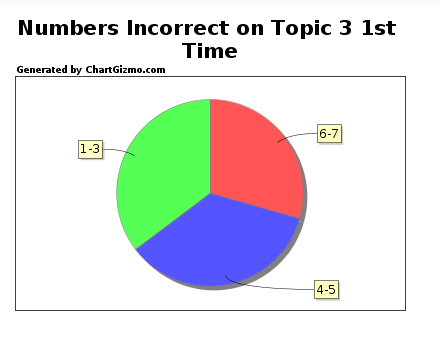


Screen shot 2014-11-23 at 7.56.12 AM.png


The numbers incorrect certainly didn't match the formative assessments that were done throughout the unit.   My colleagues shared how they gave the tests back to their students to correct only those answers that were incorrect - no reteaching - just a second chance and suggested I do the same.  So I passed back the test and asked students to correct their answers and write the new answers in colored pencil.  EVERY student did better.  The results below show the drastic difference.


The students were thrilled to have the second chance and were pleased with the results as well.  While I love the idea of letting students review their work, somewhere in the back of my mind I hear my dad saying "Measure twice, Cut once!".   The Common Core Mathematical Practice #6 states that students attend to precision:

But how do we instill the "measure twice, cut once" habit the first time around?  Is it through more practice?  Is it through showing the difference between "try #1" and "try #2"?   Would love to learn how you teach 'Attending to Precision?'

Practicing what I preach: "We all learn from our mistakes" means I'll continue to give my students their "Second Chance!"    

 

Sunday, October 5, 2014

Use of Thinking Blocks to Help Solve Math Problems

More and more we are asking students to solve complex math problems.  Along the way we do a lot to help them become successful.  We incorporate the use of many tools during the math classroom.

One of the tools we are using this year in the classroom is called, Thinking Blocks".  This website (there is even a 'free' app for the thinking blocks) poses problems around different types of models.  As a warm up before the regular math lesson this week we practiced solving addition and subtraction word problems using the "part whole model with two parts" and the "part whole model with 3 parts".

As a group we watch a quick 3 minute tutorial, practice several problems and then break off with a partner.  Using chrome books, students access the Thinking Blocks website and begin solving each new problem by first checking for understanding and then manipulating the blocks.  Working with a partner also gets the students used to 'talking' about math problems.  It's great listening in on conversations as students help one another understand why something is working or something isn't! The Thinking Blocks site also provides "feedback" when students are solving incorrectly.  It guides them so they are successful.


These Thinking Blocks help students identify the known and unknown quantities. Using these models students will gain confidence in solving problems while developing strong reasoning skills. They are also a great tool for students to use to 'discuss' math and explain their thinking. They also are a great way to incorporate many of the Standards of Mathematical Practices as students are learning to reason and make sense of the problems and persevere in solving them while using concrete models and appropriate tools. 

Eventually, students will be solving problems by creating these types of models on their own.  But for now, it's a great tool help attain understanding.

What types of models are you using with your students to help them solve problems?

Sunday, September 16, 2012

Place Value Games in Math

"2 or 20?" asks the teacher? "Twenty, twenty...twenty," whispered the students on team B. Students in the class of a second grade teacher were totally engaged playing a math game (seen in the second part of the video below). As a way to get my students thinking about "Place Value", I decided to try this with my class at the beginning of school . So we played "101 and Out" with the whole class a couple of times. Getting the hang of it quickly, the students were able to play against a partner. Here is the video from Teaching Channel if you'd like to see how it works:


At first I thought the game might be too baby-ish for fourth graders. It was just right to start the year. Soon they will play a variation called "1001 and Out". Just changing the rules a bit to suit the higher place value needs.

"High Number Toss" was the next game we played to help students with reading, writing and comparing larger numbers (into the millions). (This is an EVERYDAY Mathematics game.) It is a bit more complicated as it requires students to correctly insert commas to help them identify the numbers.


The students loved this game because they wanted to see who could create the largest number. I loved this game because it afforded me the opportunity for formative assessment. This game also has a DECIMAL version.

Finally, Who doesn't love a good Jeopardy Game? I know my students have always loved playing (especially when I take out some teacher bells for them to 'ring' in). This online version from Super Teacher Tools is a great for "Place Value Review". You can play with up to 10 Teams (or just one). Click on the picture below to play the game.


Introducing a few new games at a time is a great way to keep students engaged and learning. Please feel free to share any place value games that work in your classroom!


Sunday, January 15, 2012

Power of Math Manipulatives

Practicing subtracting with regrouping
A couple of my students were having difficulty mastering subtraction with regrouping (a skill they have been practicing since the younger grades).  It was clear they did not understand WHEN they should be regrouping and WHY they were doing so. The concept was too abstract and I knew I needed to make it more concrete.

Grabbing my bins of base ten blocks, I sat down and started using them to instruct and SHOW the meaning of subtraction.  Reviewing the idea of "trading" the tens for ones and hundreds for tens was the first step.  I then gave the students a number to 'build' with the base ten models.  From there we came up with a number to subtract. I modeled how we would use the blocks.  It was then the students turn to use the blocks to subtract (they were NOT writing yet, but I was recording each step on a white board for them to see.)  In this way, we continued through many, many problems until the kids were comfortable with the idea of subtracting and regrouping with just the manipulatives.

Eventually, I heard the words I had hoped would come,"OHhhh, I GET IT!" The math tools had worked - they students were able to make that connection between the concrete and abstract! The students were now ready to move onto the next step of using the manipulatives and recording the steps on their own to just using the algorithm. 

Base Ten Blocks, Pattern Blocks, Money, and Square Tiles are just some of the math manipulatives that are helpful to use in classrooms to help children explore the sometimes abstract  world of math.  

For teachers who don't have these types of tools available there are many Virtual Manipulatives available on line.  The following are some of those sites that help bring abstract concepts come to life.

NLVM: National Library of Virtual Manipulatives.  Manipulatives for use with PreK - Grade 12 students in the areas of Numbers and Operations, Algebra, Geometry, Measurement & Data Analysis.

Math Playground: Contains manipulatives for fractions, Algebra, angles, percents and more.

Teacher LED: A site to use with an Interactive Whiteboard to help with mathematical understanding.  (not just virtual manipulatives)

Shodor Interactivate: A site with lessons, manipulatives and activities.


OTHER RESOURCES:
How to Make the Most of Math Manipulatives: An article in Scholastic by reknowned Math Educator, Marilyn Burns with other helpful links.

Manipulating Math: Concrete Vs. Abstract:  Blog post in Teach Hub by the author of Thinking Outside the Box Blog

The Use of Manipulatives in  Math Instruction: An article in LDOnline by Louise Spear Swerling which discusses the pros and cons of using these tools.


Learning Mathematics with Virtual Manipulatives: by CITEd (Center for Implementing Technology in Education) includes an article and resources.

Subtraction with NLVM site
I have witnessed first hand the power of using math manipulatives.  When students finally grasp the meaning of those concepts that might otherwise remain abstract for years it is proof to me that those tools have a valued place in any math curriculum.

(Managing these tools can be challenging  and I find that sometimes I do not use these tools because they can be cumbersome and difficult to distribute.  I welcome your ideas on best practices with the storage and distribution. Feel free to leave your ideas in the comment section below. Also, please let me know of your success or concerns with using different math tools. 


Thursday, July 21, 2011

Slide into Summer Fun & Learning (Part 3 Math Games)


It hasn't happened in so long that we were all caught off guard.  It must have happened because of the extreme heat we have been having.  Just when we were getting ready to sit down and watch our favorite shows - the lights went out!  No television or internet! What's a child to do? 

What's a child to do?  Why, hone up on their math skills with some fun and easy games of course! Just like we did!  Playing board games or games on the computer will help keep math skills from sliding during the summer.  Here are some family favorites!

Yahtzee.  My daughter, her girlfriend and I played this game of strategy and probability that involves addition.  It was especially fun as we played by candlelight with lots of chatting and laughter.  Meanwhile, the girls, who are teenagers were practicing their basic math operations.  (For those who like playing games online there is a Yahtzee Online Version. Just make sure to turn off chat feature.)

Monopoly:  This classic board game is a sure hit with the family as they wait to see who has the most money at the end.  For older children it is a great review of counting money and you can even work on the skill of counting back change!  There is an online version by Hasbro for younger kids with a 'Lightning McQeen, Cars' theme and smaller values.  

Tower Blaster Online Game
Mancala, the ancient game with stones is a great way to practice counting and strategy.  For those who love online games try this online Mancala version or these other Math & Logic Games .   

Racko: I LOVE this game as it reminds me of my childhood. However, I use it in my classroom during math centers.  The player to put their cards in order first, wins. Click on the Racko link above to learn the rules.  An online version of this game is called "Tower Blaster".


For those computer lovers, here's a page full of fun math games is Johnnie's Math Fun.  There are all kinds of logic, puzzle and other type number games.  The logic games are even good for adults.

Revisit the games of your own childhood and you will likely find many connections to mathematics. Playing them with your child will surely bring about fond memories for all of you! 

Enjoy these lazy, hazy, crazy days of summer while they last (and have some fun connecting with your kids while practicing math!).  Let me know what games you'll be playing in the comment section!